Myopia & Children's Vision
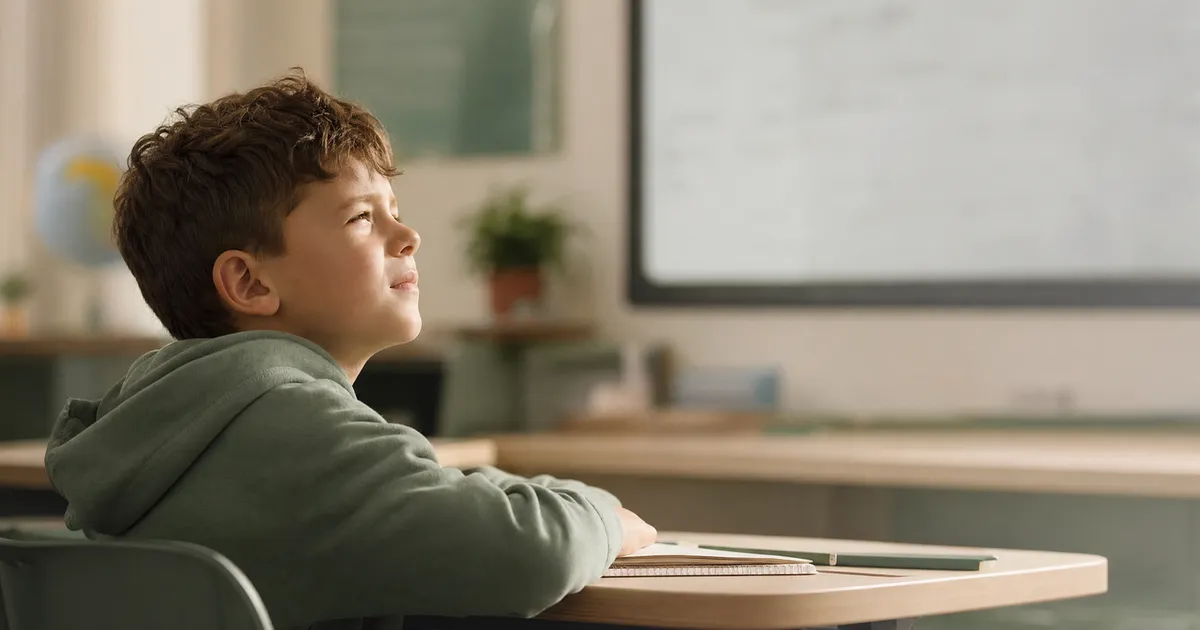
Is My Child's Vision Affecting Their Learning at School?
It is one of the most common things I see in practice, and one of the most commonly missed.
It is one of the most common things I see in practice, and one of the most commonly missed.
A child who is struggling at school. Falling behind in reading. Getting frustrated easily. Losing concentration. Maybe getting some behavioural feedback from teachers. Parents are trying everything. And no one has thought to check their eyes.
Vision problems do not always look like vision problems. Sometimes they look like learning difficulties. Sometimes they look like attention issues. Sometimes they just look like a child who is trying hard but not quite getting there.
A thorough eye examination is not going to solve every challenge a child faces at school. But it is always worth ruling out, because when vision is the issue, the difference that good glasses or treatment can make is extraordinary.
Vision problems do not always look like vision problems. Sometimes they look exactly like learning difficulties.
How much of learning is actually visual?
Around 80 percent of what a child learns in the classroom comes through their visual system. Reading, writing, copying from the board, following along, tracking text across a page. All of it relies on the eyes working properly, not just in terms of clarity, but in terms of how the two eyes work together and how efficiently the brain processes what it sees.
This means that even a relatively minor vision problem can have a significant impact on how a child copes at school. And because children adapt, and because they have nothing to compare their own vision to, they often have no idea that anything is wrong.
They just know that school is hard.
What are the signs to look out for?
Some are obvious. Many are not. Here are the things worth paying attention to:
- Squinting or screwing up their eyes, particularly when looking at the board or a screen.
- Sitting very close to the television or holding books and screens close to their face.
- Losing their place frequently when reading, or skipping lines.
- Using a finger to track along lines of text well beyond the age where this is typical.
- Avoiding reading, drawing, or any close work and becoming frustrated or avoidant when asked to do it.
- Frequent headaches, particularly at the end of the school day or after homework.
- Rubbing their eyes often, or complaining of tired or sore eyes.
- Tilting or turning their head to look at things.
- One eye that turns in or out, even occasionally.
- Short attention span for tasks that require sustained close focus.
- A noticeable drop in school performance that does not have an obvious explanation.
None of these signs on their own confirm a vision problem. But any of them are worth investigating, and several of them together are a strong signal to book an eye examination.
It is not just about clarity
This is the part that surprises most parents. A child can have perfectly clear distance vision and still have a significant vision problem.
The eyes do far more than just focus. They need to work together as a team, pointing at exactly the same spot at exactly the same time. They need to shift focus quickly and accurately between near and distance. They need to track smoothly across a line of text without jumping or losing their place. And the brain needs to process everything the eyes are sending it quickly and accurately.
When any part of this system is not working well, reading and learning become effortful in a way that is very hard to explain or identify from the outside.
Some of the most common vision-related issues we find in children include:
Convergence insufficiency
The eyes struggle to turn in and work together at close range, making reading tiring and difficult. Words can appear to move or blur. This is one of the most underdiagnosed causes of reading difficulty in children.
Accommodative dysfunction
The focussing system of the eye is not working efficiently, making it hard to sustain clear near vision for extended periods or to easily change focus from distance to near and back again.
Amblyopia (lazy eye)
One eye has significantly poorer vision than the other, often without any obvious external sign. The earlier this is caught, the better the outcome with treatment.
Hyperopia (long-sightedness)
Often missed entirely because children can compensate, but it causes significant eyestrain and can contribute to a turned eye.
Myopia (short-sightedness)
Cannot see the board clearly. Often the first thing picked up at school screenings, but there is much more to managing myopia than just prescribing glasses.
A child can have perfectly clear distance vision and still have a significant vision problem that is making school genuinely hard.
Why a school vision screening is not enough
School screenings are a useful first step. We are glad they exist. But they are not a substitute for a comprehensive eye examination, and it is important for parents to understand the difference.
A typical school vision screening checks distance visual acuity. That is, whether a child can read a letter chart from a set distance. It does not check how the eyes work together, how well they focus up close, whether one eye is significantly weaker than the other, or the health of the eyes.
A child can pass a school vision screening and still have a clinically significant vision problem. We see this regularly.
If your child has received a referral from a school screening, absolutely follow it up. But equally, if your child has passed a school screening and is still struggling, that does not mean their eyes are fine. It means a more thorough assessment is worth doing.
What about children with ADHD or ASD?
This is something I feel strongly about.
Children with attention deficit hyperactivity disorder (ADHD) or autism spectrum disorder (ASD) are not always easy to assess, and they deserve an optometrist who will take the time, adapt the approach, and genuinely work at their pace.
There is also a real and important overlap between vision problems and some of the difficulties seen in children with ADHD and ASD. Concentration, reading stamina, eye contact, visual processing. A thorough eye examination is a genuinely valuable piece of the puzzle for these children.
At Outlook Eye Centre, I have a real passion for working with kids who have additional needs. We take a calm, unhurried approach and always work at the child's pace. If you have a child with ADHD or ASD, please call us before the appointment and let us know a little about them. We will make sure we are set up to give them the best possible experience.
What we actually test
A comprehensive children's eye examination at Outlook Eye Centre covers a lot more than a letter chart. We assess:
- Distance and near visual acuity in each eye separately.
- Refractive error (short-sightedness, long-sightedness, and astigmatism), using dilating drops where appropriate to get the most accurate picture in young children.
- Eye teaming and binocular vision, including how well the eyes converge at near and maintain alignment.
- Focussing ability and stamina (accommodation).
- Eye movements and tracking.
- Eye health, including the front and back of the eye.
- Colour vision where indicated.
We will always explain what we have found in plain language and give you clear, practical recommendations about what to do next.
A note on myopia
If your child is short-sighted, prescribing glasses or contact lenses is just the beginning of the conversation.
Myopia is becoming increasingly common in children, and the research is very clear that high myopia significantly increases the risk of serious eye conditions later in life, including retinal detachment, glaucoma, and macular degeneration. The earlier myopia is detected and managed, the better the long-term outcome for your child's eye health.
At Outlook Eye Centre, we offer myopia control options including MiYOSMART lenses, which have been shown to slow myopia progression by around 60 percent on average, and orthokeratology (Ortho-K) overnight contact lenses. We also use myopia control disposable contact lenses and atropine eye drops. We also track axial length over time, which gives us a much more precise picture of whether myopia is progressing than prescription changes alone.
If your child has myopia, please ask us about myopia control at their next appointment. It is one of the most important conversations we can have.
When should children have their eyes examined?
We recommend:
- 6 months of age for a first check.
- 3 to 4 years of age, before starting school.
- Every year through primary and secondary school, or sooner if there are any concerns.
If there is a family history of turned eyes, lazy eye, or significant refractive error, we would recommend coming in sooner rather than later.
And if your child is struggling at school and no one has yet checked their eyes properly, that appointment is overdue.
Book a children's eye examination at Outlook Eye Centre. Call us on 07 4635 8844 or email andrew@outlookeyecentre.com.au. We are open Monday to Friday, 8:30am to 5:00pm, at 65 High Street, Rangeville, Toowoomba.
Shannon Smith | Optometrist | Outlook Eye Centre | 65 High Street, Rangeville, Toowoomba QLD 4350