Myopia & Children's Vision
MiYOSMART Lenses: Slowing Down Myopia Without Changing How Glasses Look or Feel
If your child has been diagnosed with myopia, the first conversation is usually about getting them glasses so they can see the board at school.
If your child has been diagnosed with myopia, the first conversation is usually about getting them glasses so they can see the board at school.
But the second conversation, the one that really matters for their long-term eye health, is about what we can do to slow down how fast the myopia progresses.
This is where MiYOSMART lenses come in. They are one of the most significant developments in children's eye care in recent years, and they are something we are genuinely excited to offer at Outlook Eye Centre.
What is myopia and why does progression matter?
Myopia, or short-sightedness, means the eyeball has grown slightly too long. Light focuses in front of the retina rather than on it, causing distant objects to appear blurry. In children, the eyeball is still growing, and myopia tends to get progressively worse throughout childhood and the teenage years.
The higher the myopia, the greater the risk of serious eye conditions in adulthood. These include retinal detachment, myopic macular degeneration, glaucoma, and cataracts. These are not minor inconveniences. They are sight-threatening conditions, and the risk increases significantly as the prescription gets higher.
This is why managing myopia in children is not just about helping them see clearly today. It is about protecting their vision for the rest of their life.
Managing myopia in children is not just about helping them see clearly today. It is about protecting their vision for the rest of their life.
What are MiYOSMART lenses?
MiYOSMART lenses are a specially designed spectacle lens developed by Hoya, one of the world's leading optical manufacturers. They look and feel like any other pair of glasses, but the lens itself is engineered to do two things at once: correct your child's short-sightedness so they can see clearly, and actively slow down how fast the myopia progresses.
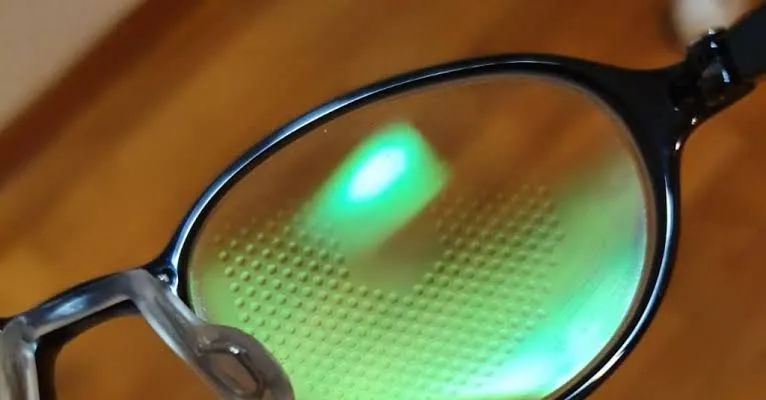
The technology behind them is called DIMS, which stands for Defocus Incorporated Multiple Segments. The lens has a central zone that corrects distance vision in the usual way, surrounded by hundreds of tiny lenslets arranged across the rest of the lens surface. These lenslets create a specific pattern of defocus on the peripheral retina that signals to the eye to slow its growth.
It sounds complex. In practice, your child just puts on their glasses and gets on with their day. They will not notice the lenslets, and the glasses look completely normal.
What does the evidence say?
MiYOSMART lenses have been backed by a landmark two-year randomised clinical trial published in the British Journal of Ophthalmology. The results were significant.
Children wearing MiYOSMART lenses showed around 60 percent less myopia progression compared to children wearing standard single vision lenses over the same period. Axial length growth, the actual physical elongation of the eyeball, was also significantly reduced.
A further study following the same cohort for six years confirmed that the effect was maintained over time, and importantly, that there was no rebound effect when children stopped wearing the lenses. This is a meaningful finding, as some myopia control treatments have shown rebound when discontinued.
The evidence is strong, and MiYOSMART is now one of the most widely recommended and prescribed myopia control options available.
Children wearing MiYOSMART lenses showed around 60 percent less myopia progression compared to standard lenses over two years.
Who are MiYOSMART lenses suitable for?
MiYOSMART lenses are suitable for most children with myopia. They work best when myopia control is started early, before the prescription becomes very high and while the eye is still actively growing. That said, they are beneficial at any stage of myopic progression.
Age range
Generally recommended from around 6 years of age, though we assess each child individually.
Prescription range
MiYOSMART lenses can be made in a wide range of prescriptions. We will let you know at the assessment whether your child is a good candidate.
Lifestyle
Because they are spectacle lenses worn during the day, MiYOSMART lenses are a great option for children who are not yet ready for contact lenses, or whose parents prefer glasses.
Children with astigmatism can also benefit, as MiYOSMART lenses are available in toric designs.
How do they compare to other myopia control options?
MiYOSMART lenses are one of several myopia control options we offer at Outlook Eye Centre. Every child is different, and having a range of approaches means we can find what suits each patient best.
The options we offer include:
- MiYOSMART lenses are worn during the day like regular glasses. No contact lens handling is involved, which makes them a natural starting point for younger children or those who are not yet comfortable with contacts.
- Orthokeratology (Ortho-K) involves rigid contact lenses worn overnight that gently reshape the cornea, giving clear vision during the day without any correction needed. It has a strong evidence base for myopia control and is popular with active children and those who prefer to be glasses-free during the day.
- MiSight contact lenses are soft daily disposable contact lenses specifically designed for myopia control. They are a great option for children who are ready for contact lenses and want the freedom of a soft lens during the day.
- Abiliti contact lenses are another soft daily disposable myopia control option, using a different optical design to slow eye growth. We will discuss whether MiSight or Abiliti is the better fit depending on your child's prescription and corneal shape.
- Atropine eye drops are a pharmacological option that uses low-dose atropine to slow myopia progression. They are typically used in cases of rapid progression or where other options are not suitable, and are often used alongside optical myopia control.
The right choice depends on your child's age, prescription, lifestyle, and what they and your family are comfortable with. Some children use one approach throughout; others move between options as they grow. We will always discuss the full picture and give you our honest recommendation.
How we monitor myopia control at Outlook Eye Centre
Prescribing MiYOSMART lenses is the beginning, not the end. We monitor myopia control actively over time to make sure the treatment is working.
One of the most valuable tools we use is axial length measurement. Rather than just tracking how the prescription changes, we measure the actual physical length of the eyeball at each review. The axial length is the most direct indicator of myopia progression, and tracking it over time gives us a much clearer picture of whether treatment is having the desired effect.
We typically review children on myopia control every six months. If the response is good, we continue. If progression is happening faster than expected, we discuss whether adjustments are needed.
What about the cost?
MiYOSMART lenses do cost more than standard single vision lenses. It is a fair question and one we hear often.
The way we encourage families to think about it is this: myopia control is an investment in your child's long-term eye health. A modest additional cost now, if it meaningfully reduces the risk of serious eye disease in adulthood, is very good value. Private health extras cover may contribute to the cost of the lenses, and we are always happy to discuss pricing openly before you make a decision.
Where to start
If your child has been diagnosed with myopia, or if you have concerns about their vision, the first step is a comprehensive eye examination. We will assess their prescription, check their axial length, discuss their history and lifestyle, and talk you through all the options available.
Myopia control is most effective when it starts early. If your child has myopia and has not yet had a conversation about management beyond glasses, please book an appointment. It is a conversation worth having sooner rather than later.
Book a myopia control assessment at Outlook Eye Centre. Call 07 4635 8844 or email andrew@outlookeyecentre.com.au. We are open Monday to Friday, 8:30am to 5:00pm, at 65 High Street, Rangeville, Toowoomba.
Shannon Smith | Optometrist | Outlook Eye Centre | 65 High Street, Rangeville, Toowoomba QLD 4350