Eye Tests & Examinations
What Actually Happens at a Comprehensive Eye Examination?
A lot of people have not had a proper eye examination in years. Some have never had one at all. And a surprising number are not entirely sure what to expect when they book one.
A lot of people have not had a proper eye examination in years. Some have never had one at all. And a surprising number are not entirely sure what to expect when they book one.
That is completely understandable. Eye examinations are not like most medical appointments, and the range of tests involved can seem a little mysterious if no one has explained what each one is actually for.
So let me walk you through what a comprehensive eye examination at Outlook Eye Centre actually involves, what we are looking for at each step, and why it matters far more than just checking whether you need glasses.
An eye examination is not just a glasses check. It is a health check for one of the most important and complex systems in your body.
Before you arrive
It helps to come prepared. Here is what to bring:
- Your current glasses, including reading glasses and sunglasses if you have them.
- Any contact lenses you wear, or the boxes they came in so we have the prescription details.
- A list of any medications you take, including eye drops. Some medications affect the eyes in ways that are worth knowing about.
- Your Medicare card and private health insurance card if you have one.
- Your family history, particularly any eye conditions such as glaucoma, macular degeneration, or a turned eye. These run in families and are relevant to how we assess you.
Step by step: what happens during your examination
A comprehensive examination typically takes around 30 minutes. Here is what we cover.
Case history
We start by talking. What brings you in today? How are your eyes feeling? Are you having any difficulties with your vision? What do you do for work and how much time do you spend on screens? Do you have any health conditions or take any medications? This conversation shapes everything that follows. A good case history is not a formality. It is the foundation of a good examination.
Visual acuity testing
The letter chart. This measures how clearly you can see at distance and at near, in each eye separately. You will be asked to read progressively smaller lines of letters. This tells us where your vision currently sits and how much, if any, correction you need.
Refraction
This is the part where we work out your prescription, or check whether your existing one is still accurate. Using a combination of automated measurement and the classic 'which is clearer, one or two?' technique, we fine-tune the prescription to the point where your vision is as clear and comfortable as it can be. For children, we sometimes use dilating drops at this stage to relax the focusing system of the eye and get the most accurate result.
Binocular vision assessment
The two eyes need to work together as a team, pointing at exactly the same place at exactly the same time. We assess how well they do this, both in the distance and up close. Problems with binocular vision can cause double vision, headaches, eye strain, and reading difficulties, and they are more common than most people realise. This assessment is particularly important for children.
Colour vision
Where relevant, we test colour vision using a series of plates that identify red-green colour deficiency. This is particularly useful for children, as colour vision deficiency can affect learning and is something parents and teachers should know about.
Eye pressure measurement (tonometry)
We measure the pressure inside each eye. Elevated eye pressure is the primary risk factor for glaucoma, and measuring it is one of the most important parts of a comprehensive eye health check.
OCT imaging
This is one of the most significant advances in optometry in recent years. We use an Optopol Revo 60 OCT (Optical Coherence Tomography) to take detailed cross-sectional images of the retina, optic nerve, and the layers beneath the retinal surface. Think of it as an ultrasound for the eye, but using light rather than sound. OCT allows us to detect changes to the retinal nerve fibre layer and optic nerve that aren't visible to the naked eye, often years before any vision loss would be apparent. It is invaluable for detecting glaucoma early and for monitoring a range of other conditions including macular degeneration and diabetic eye disease.
Slit lamp examination
A slit lamp is a specialised microscope that allows us to examine the front of the eye in high magnification. We assess the eyelids, the conjunctiva (the clear membrane covering the white of the eye), the cornea, the iris, and the lens inside the eye. This is where we look for signs of dry eye disease, blepharitis, keratoconus, cataracts, and a range of other conditions affecting the front of the eye.
Fundus examination
We examine the back of the eye, including the retina, the optic nerve head, the macula, and the blood vessels. This can be done with the OCT images, with a handheld lens, or with dilating drops when a more detailed view is needed. The back of the eye tells us a great deal about overall health as well as eye health. Changes to the blood vessels can reflect cardiovascular disease or diabetes. The optic nerve appearance gives us important information about glaucoma risk.
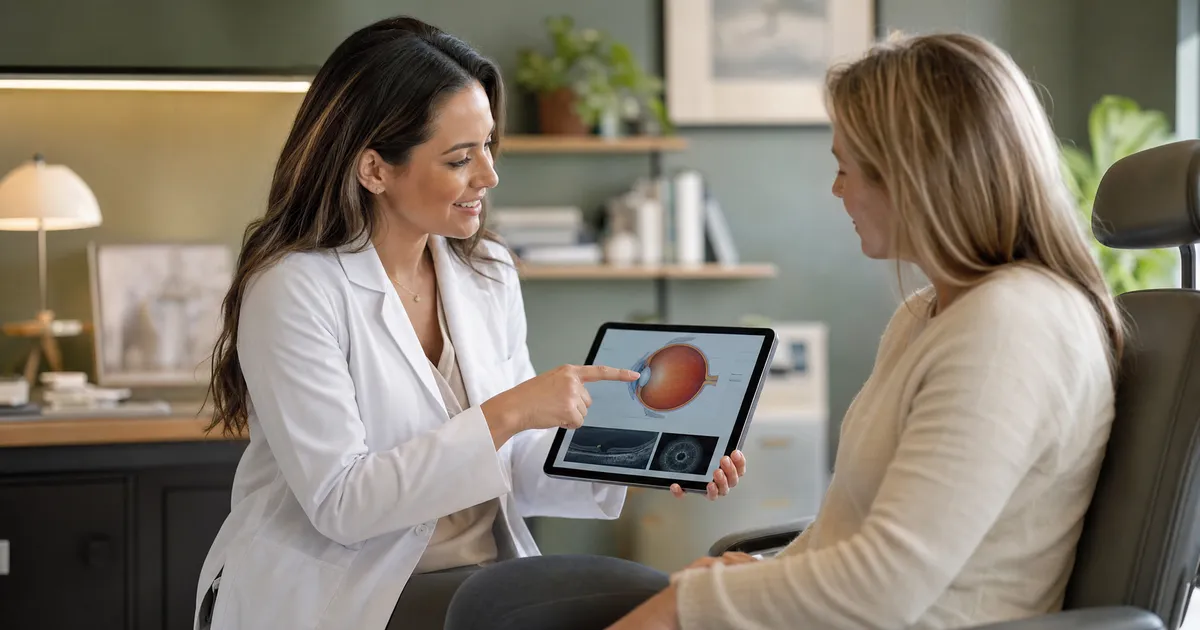
The OCT scanner lets us see changes to the optic nerve and retina that are invisible to the naked eye. It is one of the most powerful tools we have for detecting eye disease early.
What conditions can an eye examination detect?
This is the part that surprises many patients. An eye examination does not just tell you whether you need glasses. A thorough examination can detect or monitor:
- Glaucoma, often before any vision loss has occurred.
- Macular degeneration, including early changes that are invisible without the right equipment.
- Diabetic eye disease, sometimes before a patient knows they have diabetes.
- Cataracts, and how significantly they are affecting vision.
- Keratoconus and other corneal conditions.
- Dry eye disease and meibomian gland dysfunction.
- Hypertensive retinopathy, where changes to the blood vessels in the eye reflect high blood pressure.
- Retinal tears and detachment, which are sight-threatening emergencies.
- Myopia, hyperopia, astigmatism, and presbyopia, and the appropriate correction for each.
- Binocular vision disorders including convergence insufficiency and amblyopia.
For many of these conditions, the eye is the only place in the body where the blood vessels and neural tissue can be examined directly and non-invasively. A good eye examination is, in many ways, a window into overall systemic health.
What happens at the end of the appointment?
We will talk you through everything we found. Not in technical language you will need to Google afterwards, but in plain terms that make sense.
If your prescription has changed and you need new glasses or contact lenses, we will discuss the options with you. If we have found something that needs monitoring, we will explain what it is, what it means, and how often we want to review it. If something needs referral to a specialist or your GP, we will write that referral and explain why.
You will never leave an appointment at Outlook Eye Centre without knowing what we found and what happens next. That is a standard we hold ourselves to.
How often should you have an eye examination?
We recommend a comprehensive eye examination every two years for adults with no known eye health concerns. Some patients need more frequent reviews, including those with:
- Glaucoma or glaucoma risk factors.
- Diabetes.
- Macular degeneration.
- High myopia.
- A family history of significant eye conditions.
- Children on myopia control programs (every six months).
If you experience any sudden changes to your vision, new floaters or flashes of light, a shadow across your vision, eye pain, or any other concern between appointments, please do not wait for your next scheduled visit. Call us and come in.
One more thing
A lot of people put off eye examinations because they think their vision is fine. As we often say at Outlook Eye Centre: fine-feeling vision and healthy eyes are not the same thing. Some of the most serious eye conditions have no symptoms until they are already advanced.
The best time to have an eye examination is before anything feels wrong. That is when we can do the most.
Book your comprehensive eye examination at Outlook Eye Centre. Call 07 4635 8844 or email andrew@outlookeyecentre.com.au. We are open Monday to Friday, 8:30am to 5:00pm, at 65 High Street, Rangeville, Toowoomba.
Shannon Smith | Optometrist | Outlook Eye Centre | 65 High Street, Rangeville, Toowoomba QLD 4350